System
What is a System?
The System is the central data container in PowerSystems.jl. It holds all Components — the objects that describe the physical and logical elements of a power network — together with references to any associated time series data. For the most basic walkthrough of creating a system from scratch, see the Create and Explore a Power System tutorial.
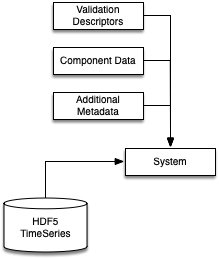
PowerSystems.jl uses a hybrid approach to data storage: component data and time series references are stored in volatile memory, while the actual time series data is stored in an HDF5 file. This design loads only the portions of the data that are relevant at the time of the query, avoiding unnecessary memory overhead for large datasets.
What is a Component?
A Component is any element of a power system model — generators, loads, buses, transmission lines, services, and more. Every component in PowerSystems.jl belongs to an abstract type hierarchy that organizes components by their role in the system (see Type Structure for details).
A key constraint of the data model is that a component instance can belong to at most one System at a time. Adding a component to a second System without first removing it from the first will raise an error. This ensures that ownership of component data is unambiguous and prevents silent aliasing between systems.
Accessing components stored in the System
PowerSystems.jl implements a wide variety of methods to search for components to aid in data manipulation. Most of these use the Type Structure to retrieve all components of a certain Type.
The most common retrieval function is get_components, which accepts a concrete or abstract component Type and returns all matching components from the System. It also accepts filter functions for more refined searches.
Because a system can contain a large number of components, PowerSystems.jl returns Julia iterators rather than materialized collections, avoiding unnecessary memory allocations. The container is internally optimized for iteration over both abstract and concrete component types.
Accessing data stored in a component
Using the "dot" access to get a parameter value from a component is actively discouraged, use getter functions instead
Using code autogeneration, PowerSystems.jl implements getter functions to enable the retrieval of parameters defined in the component struct fields. Julia syntax enables access to this data using the "dot" access (e.g. component.field), however this is actively discouraged for two reasons:
- We make no guarantees on the stability of component structure definitions. We will maintain version stability on the getter methods.
- Per-unit conversions are made in the return of data from the getter functions. (see the per-unit section for more details)
Subsystems
The System also supports partitioning components into named subsystems, which is useful for decomposition approaches or dispatch coordination workflows. For a hands-on walkthrough of working with a System, its components, and the accessor functions, see the Manipulating Datasets tutorial. For a step-by-step guide, see Use subsystems.