Grouping generators into plants
The unit vs. plant aggregation problem
In power systems modeling, there is a fundamental tension between different levels of aggregation. Real-world power plants often consist of multiple generating units that share physical infrastructure, but data sources and modeling requirements vary in how they represent this relationship:
- Unit-level data: Individual generators with their own capacity, cost curves, and operational constraints
- Plant-level data: Aggregated capacity and characteristics representing an entire facility
For interoperable analysis across different tools and datasets, it is often necessary to track both the plant and the individual units within it. This is particularly important when:
- Data integration: Combining datasets that use different aggregation levels
- Shared infrastructure constraints: Units on the same shaft, penstock, or point of common coupling have operational dependencies that must be modeled together
- Market operations: ISOs may require unit-level bidding while planning studies use plant-level data
- Regulatory reporting: Different reports require different aggregation levels
PowerSystems.jl addresses this challenge through plant supplemental attributes — SupplementalAttribute types that group individual generator components into logical plant structures while preserving the detailed unit-level information.
Plant attribute types by technology
PowerSystems.jl provides five plant attribute types, each designed for a specific generation technology. The Type Tree shows how they relate under the PowerPlant abstract type.
Thermal power plants
ThermalPowerPlant represents conventional thermal power plants with synchronous generators. Multiple units can share a common shaft, which is relevant for modeling mechanical coupling constraints.
Combined cycle blocks
CombinedCycleBlock represents combined cycle plants using a block configuration. Models the relationship between combustion turbines (CTs) and steam turbines through the Heat Recovery Steam Generator (HRSG). Combined cycle plants are typically described using a "CTs x STs" notation (e.g., 2x1 means two combustion turbines feeding one steam turbine through an HRSG). EIA PrimeMovers codes use CT and CA to distinguish the combustion turbine units from the steam portion of the combined cycle.
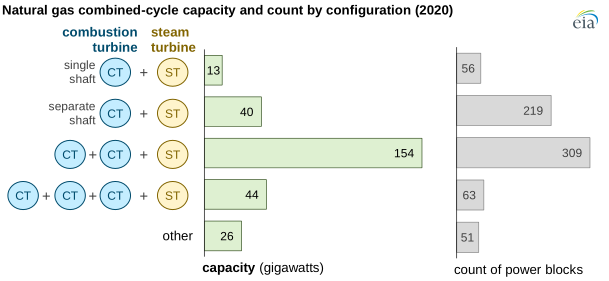
For more information on combined cycle configurations, see the U.S. Energy Information Administration article on combined-cycle plants.
Combined cycle fractional plants
CombinedCycleFractional represents combined cycle generation when each unit represents a specific operating configuration. Unlike CombinedCycleBlock, which models the CT/CA relationship through the HRSG, the fractional representation uses operation exclusion groups to define which units can operate simultaneously. Only generators with the CC PrimeMovers type can be added. Heat rates and cost curves remain on the individual generator structs; the plant attribute captures which configurations are mutually exclusive.
Hydro power plants
HydroPowerPlant represents hydroelectric plants where multiple turbines may share a common penstock (the pipe that delivers water to the turbines). Shared penstocks create operational dependencies between units.
Reservoir-to-turbine hydraulic topology (HydroReservoir links) is modeled separately; see Hydro reservoir topology.
Renewable power plants
RenewablePowerPlant represents renewable energy plants (wind farms, solar farms) where multiple generators or storage devices connect through a common Point of Common Coupling (PCC) to the grid.
Choosing a representation
| Situation | Typical choice |
|---|---|
| Multiple thermal units on shared shafts | ThermalPowerPlant |
| Combined cycle with explicit CT → HRSG → CA topology | CombinedCycleBlock |
| Combined cycle with mutually exclusive operating modes per unit | CombinedCycleFractional |
| Multiple hydro turbines on a shared penstock | HydroPowerPlant |
| Wind or solar farm with shared grid connection | RenewablePowerPlant |
Field definitions, supported component types, and accessor functions are documented in the Public API Reference under Supplemental Attributes.
See also
- Supplemental attributes — the general concept
- Group generators into plants — step-by-step attachment